
Contributor: Juliet Huffman, Director of Marketing: FINBOA
Payment dispute processing is becoming more complex as financial institutions balance growing operational demands, fraud risk and regulatory requirements.
During FINBOA’s recent webinars, we asked banking professionals to share the challenges creating the most pressure for their dispute teams.
The results point to three areas that stand out:
- Errors and missing information.
- Risk and claim-related losses.
- Regulatory timelines and audit readiness.
For financial institutions still relying heavily on manual processes, these challenges compound quickly. Each additional step creates another opportunity for incomplete information, processing delays, or inconsistent workflows.
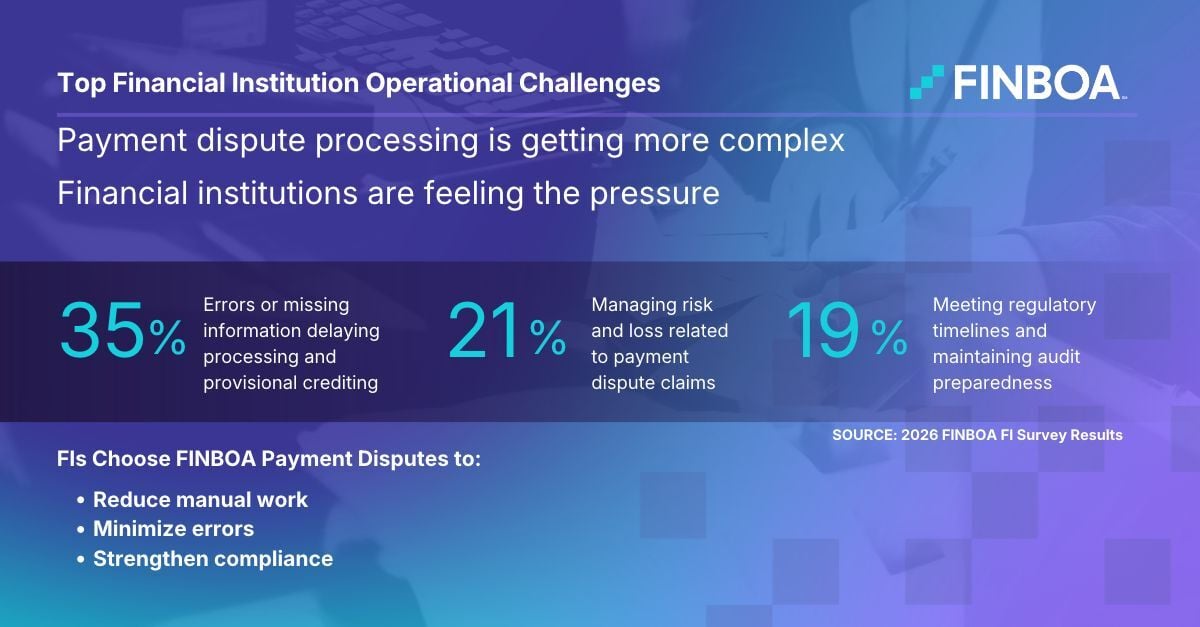
The Biggest Challenges Facing Dispute Operations
When asked about the biggest challenges impacting payment dispute processing, we surveyed several hundred people across multiple webinars and identified the following results.
35% of respondents reported errors or missing information that delay processing and provisional crediting cause additional work for dispute teams.
Staff need to follow up for additional documentation, correct data errors, or manually review information before a claim can move forward. These delays jeopardize a team’s ability to meet strict regulatory timelines.
21% of respondents reported managing risk and losses related to payment dispute claims have a significant impact on financial institutions
Teams need to evaluate claims, gather supporting documentation, and make decisions while balancing customer experience with fraud and loss prevention. Manual processes can make it harder to apply consistent workflows across high volumes of cases.
19% respondents reported that meeting regulatory timelines and maintaining audit preparedness continues to add layers of complexity.
Under Reg E, financial institutions have specific error-resolution obligations, including investigation and notification requirements. Depending on the circumstances, institutions may also need to provide provisional credit within specified timeframes.
That means dispute teams need more than an efficient way to process claims. They also need processes that provide visibility into each case and support consistent documentation and compliance.
Why Manual Processes Create More Pressure
Manual dispute processing amplifies each of these operational bottlenecks.
When information is collected across multiple systems, staff spend significant time entering data, searching for documentation, reviewing transactions, and moving cases between workflows. As dispute volumes rise, manual tasks consume valuable staff capacity without improving resolution speed or accuracy.
The result is a predictable cycle:
More disputes → More manual work → Greater opportunity for errors → More staff intervention → Higher operational costs
Automation breaks that cycle by standardizing repetitive processes and connecting the information needed to manage a dispute.
Middletown Valley Bank has shared their experience in transforming manual processes with dispute automation software. View the Middletown Valley Bank story here.
Automation Can Address the Bottlenecks
The goal of dispute automation isn't simply to eliminate manual tasks. It's to create a more consistent process that helps staff focus their time where human judgment is most valuable.
An automated dispute workflow helps financial institutions:
- Capture complete information upfront to reduce errors and missing documentation.
- Standardize workflows so cases move through the appropriate steps consistently.
- Automate repetitive tasks that consume staff time.
- Improve visibility into dispute status, activity, and required actions.
- Support compliance by creating consistent processes and documentation.
- Reduce operational risk by minimizing manual errors and missed steps.
- Scale dispute operations without requiring a proportional increase in staff.
For teams managing payment disputes today, these capabilities can make a meaningful difference as volumes and complexity continue to grow.
Integration Matters Too
Automation is most effective when it fits into a financial institution's existing technology environment.
A dispute platform that integrates with the institution's core and other systems eliminates the need for duplicate data entry and helps information move more efficiently between processes.
Instead of creating another disconnected system for staff to manage, integrated automation can become part of the existing dispute workflow. This is particularly important for financial institutions considering automation for the first time.
The right solution should not only automate the work, but also make the transition from manual processing as straightforward as possible.
Moving From Manual Bottlenecks to Smarter Dispute Operations
The survey results highlight a common challenge: dispute teams are being asked to do more while managing increasingly complex requirements.
Errors and missing information were the top concern among webinar participants, followed by risk and claim-related losses and regulatory timelines. While each challenge is distinct, they share a common root cause: manual processes can make all three harder to manage.
Automation provides an opportunity to reduce that burden by connecting workflows, improving information quality, and giving teams greater visibility into the dispute lifecycle.
For banks and credit unions evaluating their next step, the question is not whether dispute operations need to evolve. It’s how much of the process can be automated while maintaining the control, visibility, and compliance their teams require.
FINBOA helps financial institutions automate payment dispute workflows to reduce manual work, improve accuracy, and strengthen operational control.
Request a demo to learn how automated dispute processing can help your institution reduce bottlenecks and modernize dispute operations.